NetBird Review: WireGuard Mesh, CGNAT & Alternatives (2026)
Explore NetBird open-source WireGuard mesh networking. Fix CGNAT relay latency spikes, configure reverse proxy for self-hosting, and compare dedicated port forwarding VPNs.
Quick Answer: What Is NetBird Used For and How Does It Compare to Tailscale?
NetBird is an open-source, zero-configuration overlay networking platform built on WireGuard that connects private machines, Docker containers, and home labs into an encrypted peer-to-peer mesh. While NetBird provides an exceptional self-hostable alternative to Tailscale with kernel-speed WireGuard, it encounters fundamental limits when self-hosting public workloads: behind Carrier-Grade NAT (CGNAT) or Symmetric NAT, peer-to-peer hole punching fails, forcing traffic through relay servers that add 100ms+ latency and jitter. Furthermore, reverse proxying through NetBird requires all external visitors to install the NetBird client. For public-facing hosting (Palworld, Minecraft, Plex) without visitor software or relay bottlenecks, a commercial VPN with a Dedicated IP and port forwarding (such as PureVPN or Proton VPN) is the superior choice.
NetBird NAT Traversal & Relay Latency Impact Calculator
Many developers and home lab builders turn to NetBird (via netbird download on their official website or the netbird github repository) to connect machines across firewalls without opening router ports. But what happens when you deploy netbird vpn on cellular 5G home internet, Starlink, or behind Carrier-Grade NAT (CGNAT)? Select your network topology below to predict peer-to-peer success versus relay latency degradation:
Interactive NetBird P2P vs Relay Analyzer
Select your upstream NAT condition to see whether WireGuard connects directly or falls back to high-latency relays:
Relay Fallback (Coturn / DERP)
+80 to +160 ms (Severe Ping Spike)
Throttled by Public Relay Nodes
Technical Assessment: Direct handshake impossible. Traffic bounces through third-party relays, unplayable for games.
What Is NetBird Used For? (Kernel WireGuard Mesh vs Relay Fallbacks)
If you are asking what is netbird or wondering what is NetBird used for, it is an open-source overlay networking solution designed to build zero-trust private meshes. It connects disparate servers, laptops, and virtual machines by orchestrating peer-to-peer WireGuard tunnels directly between endpoints.
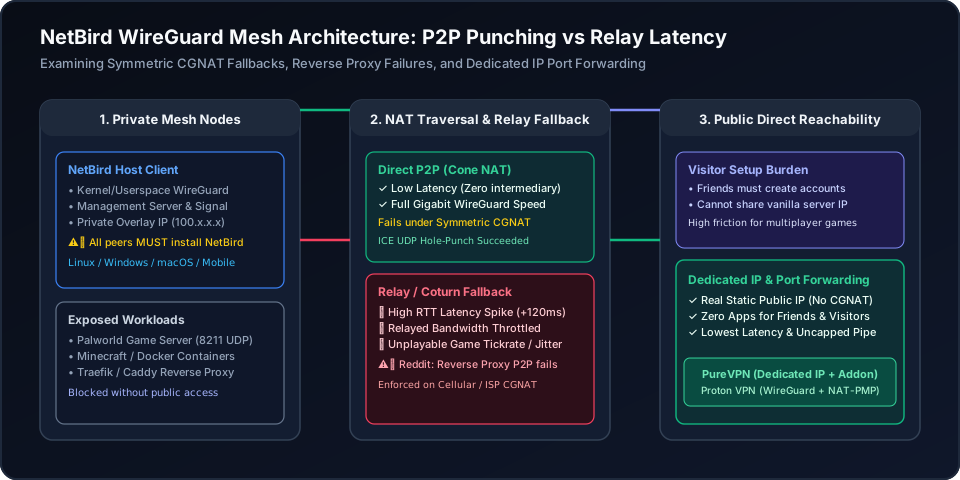
Kernel-Speed WireGuard Performance
When you complete a netbird install on Linux, the netbird client operates in kernel space using the native WireGuard module. This provides significantly lower CPU overhead and higher packet-per-second throughput compared to user-space implementations.
Through the web-based netbird dashboard, network operators manage access policies, DNS configurations, and multi-factor authentication seamlessly.
The Relay Fallback Trap
NetBird relies on WebRTC ICE (Interactive Connectivity Establishment) with STUN/TURN servers to punch through firewalls. When both peers are behind standard Cone NAT, connection is direct and instantaneous.
However, when either peer is on 5G cellular, mobile tethering, or strict ISP CGNAT, UDP hole punching fails. NetBird automatically downgrades the connection to a relayed tunnel, passing every packet through public Coturn relays and inducing noticeable latency spikes.
NetBird vs Tailscale: Which Mesh Network Is Better in 2026?
Developers researching netbird vs tailscale frequently ask: "Is NetBird like Tailscale?" and "Is NetBird completely free?" While both leverage WireGuard for encrypted overlay meshes, their licensing, performance architecture, and self-hosting capabilities differ significantly:
| Feature | NetBird | Tailscale | Dedicated Port Forwarding VPN |
|---|---|---|---|
| Control Plane Open Source? | 100% Fully Open Source | Proprietary (Headscale needed) | Commercial Managed Fleet |
| WireGuard Implementation | Kernel Module (Linux) | Userspace (wireguard-go) | Optimized WireGuard Stack |
| Bypasses CGNAT? | Yes (P2P or Coturn Relay) | Yes (P2P or DERP Relay) | 100% Guaranteed Native IP |
| Public Visitor Access? | Client app required on all peers | Client app required on all peers | Zero Apps (Direct IP/Domain) |
| Gaming Server Suitability | High friction for friends | High friction for friends | Standard Port (25565 / 8211) |
| Pricing & Cost | Free 100 peers / $5 team | Free 3 users / $6 team | ~$2.50/mo Unlimited Devices |
Solving NetBird Reverse Proxy & Game Server Connection Failures
On community platforms like Reddit (r/netbird and r/selfhosted), users consistently face friction when trying to adapt NetBird for public hosting. Let us diagnose the top issues:
1. Why NetBird Reverse Proxy Fails for Palworld & Minecraft Servers
In a prominent Reddit thread ("Can't get reverse proxy to work - Palworld server"), a user hosted a dedicated Palworld server and configured Traefik on an external VPS over NetBird. The server reported zero inbound connection logs, and external players could not connect.
The Root Cause: Games like Palworld communicate exclusively over UDP port 8211. Standard reverse proxies (like Nginx or basic Traefik HTTP routes) do not forward raw UDP datagrams without complex Layer-4 stream configurations. Furthermore, NetBird assigns private overlay IP addresses (100.x.x.x). Unless external players also download the NetBird client, join your network tenant, and receive authorized ACL rules, they cannot route traffic to your game container.
2. The Reverse Proxy P2P Latency Trap
Another frequent inquiry ("Reverse Proxy P2P - relay latency" and "Advice for remote connections") centers on unexpected lag. A home lab host with a temporary public IP still suffered from relayed traffic. When Carrier-Grade NAT or strict router firewalls prevent UDP hole punching, NetBird routes the entire reverse proxy data stream through a shared Coturn relay.
This introduces severe round-trip time (RTT) degradation—turning a 25ms local connection into a 140ms jittery disaster that ruins online gameplay and audio/video streaming.
The Permanent Fix: Dedicated IP & Unthrottled Port Forwarding
Do not force your gaming friends or visiting clients to install mesh software or suffer through relayed ping spikes. A dedicated port-forwarding VPN gives your server an unmetered, public gateway through residential CGNAT.
PureVPN Dedicated IP + Port Forwarding
- Direct Public Connectivity: Assigns a fixed static IPv4 address. Friends connect with your standard IP:port (e.g.
25565or8211) with zero apps. - No Relay Lag or Jitter: Completely eliminates Coturn or DERP relay hops. Enjoy direct gigabit throughput and optimal game tickrates.
- 100% CGNAT & Firewall Proof: Seamlessly punches outbound through Starlink, 5G cellular, or strict university firewalls.
- Apex Domain Binding: Attach any custom apex domain via a standard DNS A-record without purchasing enterprise SaaS subscriptions.
Proton VPN Plus (WireGuard + NAT-PMP)
- 10 Gbps WireGuard Infrastructure: Experience wire-speed encrypted throughput engineered in Switzerland for extreme workloads.
- Automated NAT-PMP Mapping: Compatible with P2P clients and self-hosted tools that support dynamic port negotiation.
- Independently Audited Zero Logs: Legally protected by Swiss privacy jurisprudence with 100% open-source applications.
- Integrated Ad & Malware Shield: NetShield blocks telemetry, trackers, and malicious botnet endpoints at the DNS level.
This page contains affiliate links. If you sign up through them, NAT Checker may earn a commission at no extra cost to you.
How to Deploy NetBird WireGuard Mesh or Upgrade to Dedicated Port Forwarding
1. Install NetBird Client on Your Host System
Download the NetBird client for Linux, Windows, macOS, or Docker from netbird.io/docs. Run the install script or container definition on your target server.
curl -fsSL https://pkgs.netbird.io/install.sh | sh
2. Connect and Authenticate via the NetBird Dashboard
Execute "netbird up" in your terminal. Follow the browser link to authenticate via the NetBird Cloud management console or your self-hosted management instance.
3. Configure Network Routing, DNS, and Access Policies
Assign static 100.x.x.x overlay IPs, define routing peers for LAN subnet sharing, and set up access control rules in the NetBird admin panel.
4. Audit Connection Status: Direct P2P vs Relay Fallback
Run "netbird status --detail" to verify peer connections. If your status shows "Relayed" instead of "P2P", your connection is throttled through Coturn relays due to CGNAT.
5. Upgrade to a Dedicated Port Forwarding VPN for Public Hosting
To allow external players to join without client software and eliminate high-latency relay bottlenecks, connect your game or media server to PureVPN Dedicated IP or Proton VPN.
NetBird & WireGuard Mesh FAQ
Detailed technical answers to common questions about NetBird, Tailscale, pricing, and CGNAT hosting:
What is NetBird used for and how does it work?
NetBird is used to build secure, private virtual mesh networks across distributed devices, cloud servers, and home lab systems without configuring firewall rules or port forwarding. It operates by combining modern WireGuard encryption with an automated signaling service (ICE/STUN/TURN) to negotiate direct peer-to-peer UDP connections between devices, assigning each machine a private overlay IP (100.x.x.x).
Is NetBird completely free and how much does it cost?
NetBird is 100% open-source and free to self-host without device limits using their official GitHub repository and Docker containers. For cloud-managed hosting, NetBird offers a generous Free tier covering up to 100 peers and basic routing features. Paid plans (Team and Enterprise) start at $5/user/month and introduce advanced identity provider integrations, posture checks, and dedicated relay infrastructure.
NetBird vs Tailscale: what are the key differences?
Both platforms use WireGuard for peer-to-peer overlay networking, but differ in key architectural areas: 1) NetBird is fully open-source from control plane to client (Tailscale control server is proprietary, requiring community Headscale); 2) NetBird utilizes native kernel WireGuard on Linux by default for lower CPU usage and maximum throughput, whereas Tailscale uses a userspace Go implementation (wireguard-go); and 3) NetBird features built-in routing peer election and self-hosted Zitadel authentication.
Why does NetBird reverse proxy fail on game servers like Palworld or Minecraft?
Home lab users frequently struggle when deploying reverse proxies (Traefik, Nginx, Caddy) over NetBird for game hosting. NetBird creates a private overlay network, meaning external players cannot reach the server unless they also join the same NetBird management tenant. Additionally, reverse proxying UDP-based games like Palworld (port 8211) requires complex L4 stream forwarding and container host-network bindings that often fail behind multi-tenant CGNAT.
Why do NetBird connections fall back to relay servers and cause high latency?
NetBird attempts direct P2P connections using STUN hole punching. However, when one or both peers sit behind Symmetric NAT or Carrier-Grade NAT (common on cellular home internet and rural fiber), the router assigns random external source ports for each destination, making direct hole punching impossible. NetBird must then route traffic through Coturn/Relay servers, causing ping spikes of 80–150ms and packet jitter.
Can friends or external users connect to my NetBird server without installing software?
No. Every visitor who wants to connect to a service hosted on a private NetBird mesh IP must install the NetBird client, register an account, and be granted access via the NetBird dashboard ACL rules. For hosting multiplayer gaming servers, media libraries, or web demos, this creates severe user friction compared to a standard public IP.
Why choose a commercial port-forwarding VPN over NetBird for server hosting?
A dedicated port-forwarding VPN (like PureVPN or Proton VPN) solves the public hosting dilemma: 1) Gives your server a clean, static public IPv4 address that bypasses CGNAT completely; 2) External friends connect directly using your IP or custom domain with zero client apps; 3) Guarantees unthrottled gigabit speeds with low gaming ping by eliminating relay servers; and 4) Completely isolates your home network from external attack vectors.
Authoritative Protocols & Diagnostic Resources
- NetBird Official Documentation & Architecture Guide
- NetBird Open-Source GitHub Repository
- WireGuard Fast, Modern, Secure VPN Tunnel Technical Paper
- NatChecker: Complete WireGuard Port Forwarding & CGNAT Setup
- NatChecker: How to Port Forward Behind CGNAT Without Static IP
- NatChecker: Palworld Port Forwarding & Server Hosting Guide
- NatChecker: Best Cloudflare Tunnel Alternatives for Self-Hosters
- NatChecker: Netmaker WireGuard Mesh & Ingress Behind NAT Guide
- NatChecker: Firezone VPN WireGuard Web UI & CGNAT Setup Guide
- NatChecker: OpenZiti Zero-Trust Overlay & CGNAT Rendezvous Guide